

Character and Citizenship Education
Key Department-Led School Programmes
Character Education
In CCKPS, we believe that every child is a leader, a leader in the personal
and social domains. Students learn how to be an effective leader
during Form Teacher Guidance Period (FTGP). These lessons are part of the
total curriculum, with dedicated curriculum time, and are used to engage
and build relationships with our students through discussions and the use
of effective classroom strategies.
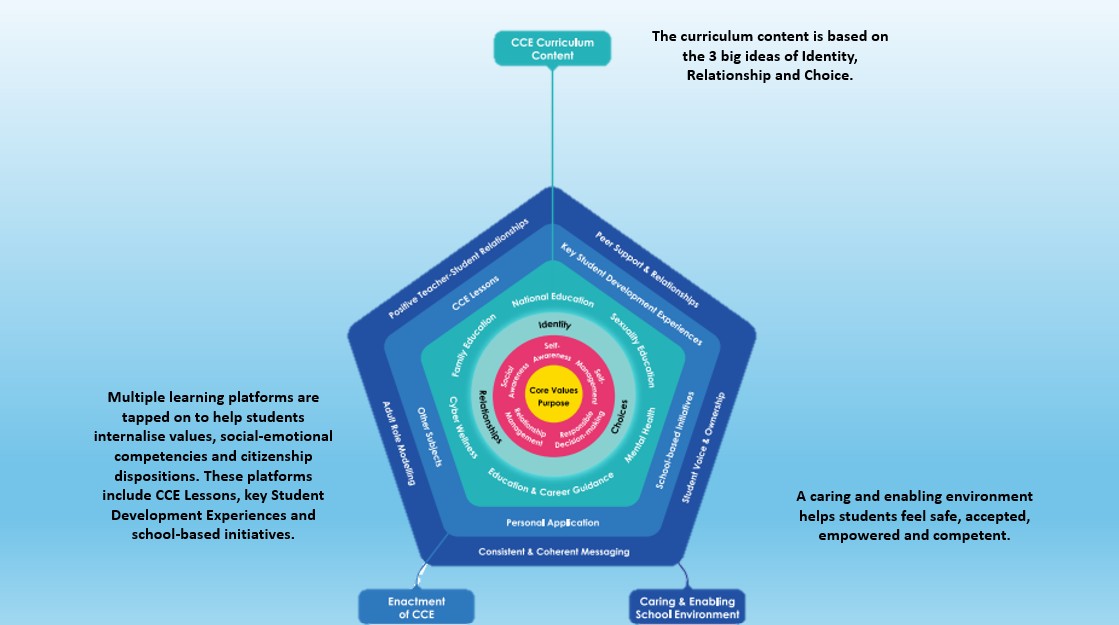
Our CCE programme nurtures students holistically through explicit teaching
of values, social emotional skills, and cultural identity. Students learn
to understand and regulate their emotions, build healthy relationships,
make responsible decisions, and deepen their moral values and appreciation
of their own cultural heritage.
CCE also equips students with real world knowledge and life skills. Lessons
help students understand mental health, navigate cyberspace safely, make
informed education and career choices, appreciate family life, and develop
a strong understanding of Singapore’s racial and religious diversity.
Students are further empowered to contribute meaningfully through Values
in Action (VIA). They identify needs in their family, school, or community,
plan purposeful projects, and reflect on their learning—strengthening empathy,
responsibility, and active citizen.
Programmes & Activities
Pre-assembly and Assembly Talks
The pre-assembly and assembly talks aim to create a learning, thinking
and reflecting environment for the students.
Recess Activities
The varied recess activities allow students to continue their learning
beyond the classroom.
Positive Teacher-Student Relationship
We can establish positive teacher–student relationships when we take time
to intentionally connect with individual students in class. We do this
by setting aside time or tap on the allocated school time to have one-to-one
teacher–student interactions to know students better. Through the one-to-one
conversations, we can get to know our students better, asking them about
their interests, their family, their classmates/friends, and how they spend
their time after school hours. By establishing rapport with our students,
we will build positive teacher–student relationships and this will lead
to positive student outcomes in terms of their learning, relationship management
with others as well as their wellbeing.
Every Student a Peer Supporter
Every student can be a peer supporter when they foster strong bonds of
friendship and a sense of belonging to the school community (peer bonding),
provide practical help and social-emotional support to one another (peer
helping) and promote positive mindsets, prosocial behaviours and well being
(peer influencing).
We can intentionally create platforms and opportunities for all students
to interact and strengthen their social network and friendships. These
also allow students to practise and reinforce their peer support mindsets
and skills to look out for and support their classmates in need.